
As a business owner, you know that having cash in the bank is critical to keeping your business running. But how do you track where your cash is coming from and where it’s going? That’s where your cash flow statement comes in.
Unlike your profit and loss statement, which shows if your business is profitable on paper, the cash flow statement reveals the actual cash moving in and out of your business. At ECB Administrative Services we help clients make sense of their financials, and today, we’ll explain how to read a cash flow statement in simple terms, using an example from Sarah’s coffee shop from the previous blog article. This will help you avoid the surprise Sarah faced: a profitable business with almost no cash in the bank.
What Is a Cash Flow Statement?
A cash flow statement is a financial report that shows how cash enters and leaves your business over a period (e.g., a month or a year). It answers three questions:
- Where did your cash come from? (e.g., sales or loans)
- Where did your cash go? (e.g., expenses or equipment)
- How much cash do you have left?
This is different from profit, which counts sales and expenses when they’re recorded, not when cash changes hands. In our last post, we talked about Sarah’s coffee shop, which showed a $40,000 profit but only $5,000 in the bank.
Why? Her cash was tied up in unpaid invoices, equipment purchases, and loan repayments. A cash flow statement would have shown her exactly why her bank account was low, helping her plan better.
The Three Parts of a Cash Flow Statement
A cash flow statement is divided into three sections. Here’s what each one means, using Sarah’s coffee shop as an example:
- Cash Flow from Operating Activities
This section shows the cash your business makes (or spends) from its core operations, like selling products or paying for rent, staff, and supplies. It focuses on cash actually received or paid, not just recorded sales or expenses.
- What to Look For:
- Positive Number: You’re collecting more cash from customers than you’re paying for expenses—good news!
- Negative Number: You’re spending more cash than you’re collecting, which could mean trouble (e.g., customers paying late).
- Sarah’s Example:
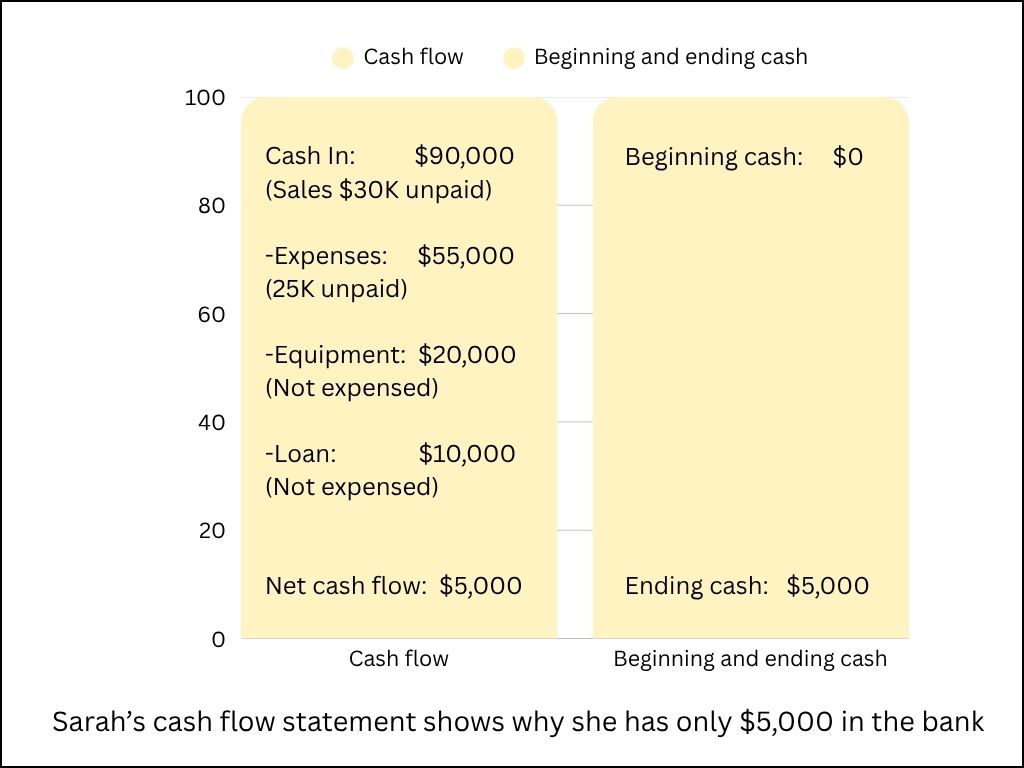
Last year, Sarah’s coffee shop had $120,000 in revenue, but $30,000 was from unpaid catering invoices, so she received $90,000 in cash from sales. She paid $55,000 in cash for expenses like rent, payroll, and supplies. (Her total expenses were $80,000, but $25,000 was unpaid bills, like supplier invoices, which didn’t affect cash.) Her net cash from operations is $90,000 – $55,000 = $35,000. This positive number shows her core business generated cash, but it’s less than her $40,000 profit because of unpaid invoices and bills.
- Cash Flow from Investing Activities
This section tracks cash spent on or received from long-term investments, like buying equipment or property. These are often big purchases to grow your business.
- What to Look For:
- Negative Number: Common when you buy assets like equipment, reducing cash but not profit (since these are capitalized, not expensed).
- Positive Number: Rare, but happens if you sell assets.
- Sarah’s Example:
Sarah spent $20,000 on a new espresso machine, a long-term asset. This shows as a negative $20,000 in investing activities because the cash left her bank, even though it didn’t reduce her profit (the machine is depreciated over time).
- Cash Flow from Financing Activities
This section shows cash flows related to financing your business, like taking out loans, repaying loans, or paying dividends to owners.
- What to Look For:
- Positive Number: You’re bringing in cash (e.g., a new loan).
- Negative Number: You’re paying out cash (e.g., loan repayments).
- Sarah’s Example:
Sarah paid $10,000 toward her loan’s principal, which shows as a negative $10,000 in financing activities. This cash payment didn’t affect her profit because loan principal repayments aren’t expenses.
Putting It All Together:
Net Cash Flow and Cash Balance
At the bottom of the cash flow statement, you’ll see:
- Net Cash Flow: The total of cash flows from operating, investing, and financing activities. It shows whether your cash increased or decreased.
- Beginning Cash Balance: The cash you started the period with.
- Ending Cash Balance: Beginning balance plus net cash flow, showing the cash in your bank at the end.
Sarah’s Example:
For the year:
- Operating Activities: +$35,000 (cash from sales minus paid expenses).
- Investing Activities: -$20,000 (espresso machine).
- Financing Activities: -$10,000 (loan repayment).
- Net Cash Flow: $35,000 – $20,000 – $10,000 = $5,000.
- Beginning Cash Balance: $0 (assuming she started the year with no cash for simplicity).
- Ending Cash Balance: $0 + $5,000 = $5,000 (her bank balance).
This explains why Sarah’s bank account has only $5,000, even though her profit was $40,000. The cash flow statement shows how unpaid invoices ($30,000), unpaid bills ($25,000), equipment purchases, and loan repayments created the gap.
Why It Matters
Your cash flow statement helps you:
- Understand Cash Shortages: Sarah’s statement shows how unpaid invoices and big purchases drained her cash, despite high profit.
- Plan for Big Expenses: Seeing investing and financing activities helps you time equipment purchases or loan repayments.
- Make Smart Decisions: Knowing your cash position helps you decide whether to chase payments, delay spending, or seek financing.
Tips for Using Your Cash Flow Statement
- Review It Often: Check monthly or quarterly to spot trends or issues.
- Compare to Profit: Use it alongside your profit and loss statement to understand why your bank balance differs from profit.
- Get Expert Help: Work with a bookkeeper (like us!) to ensure your statement is accurate and to learn what the numbers mean for your business.
Your cash flow statement is like a window into your business’s cash health. By understanding its three parts—operating, investing, and financing activities—you can see why your bank account might not match your profit, just like Sarah’s coffee shop. At ECB Administrative Services, we’re here to help you read and use your cash flow statement to keep your business thriving. Contact us today for a free consultation to simplify your financials!