
As a business owner, you might look at your financial statements and see a healthy profit, only to check your bank account and wonder, “Where’s all the money?” This is a common question we hear at ECB Administrative Services, and it’s a great opportunity to clarify the difference between profit and cash flow. These two concepts are not the same and understanding how money flows through your business can help you make smarter financial decisions. Let’s break it down in simple terms.
Profit vs. Cash Flow: What’s the Difference?
Profit is the money your business has left after subtracting all expenses from your revenue. It’s what your income statement shows at the end of the year. For example, if you earned $100,000 in sales and spent $70,000 on expenses (like rent, supplies, and payroll), your profit is $30,000.
Cash flow, on the other hand, is the actual movement of money in and out of your bank account. It’s about when money comes in and goes out, not just how much. Even if your business is profitable on paper, timing issues or other factors can leave your bank account looking empty.
Why Don’t They Match?
Here are some common reasons why your profit might not show up as cash in the bank:
- You Haven’t Been Paid Yet
If you sell products or services on credit (e.g., invoicing clients to pay later), your financials count that sale as revenue when the sale is made, not when you get paid. If clients owe you $20,000, that amount is part of your profit, but it’s not in your bank until they pay.
- You’re Paying Expenses Upfront
Some expenses, like inventory, equipment, or annual subscriptions, require you to pay cash upfront. These costs might not fully hit your income statement yet (they could be spread out over time as depreciation or inventory costs), but the money is already gone from your bank.
- Debt Repayments
When you repay loans, only the interest portion affects your profit. The principal (the original amount borrowed) reduces your cash but doesn’t show up as an expense on your income statement.
- Investing in Growth
If you’re spending money on things like new equipment, renovating a store, or purchasing a commercial vehicle to grow your business, that cash leaves your bank account. These investments might not count as expenses right away (some are capitalized over time), so your profit looks good, but your cash is tied up.
A Simple Example:
Sarah’s Coffee Shop
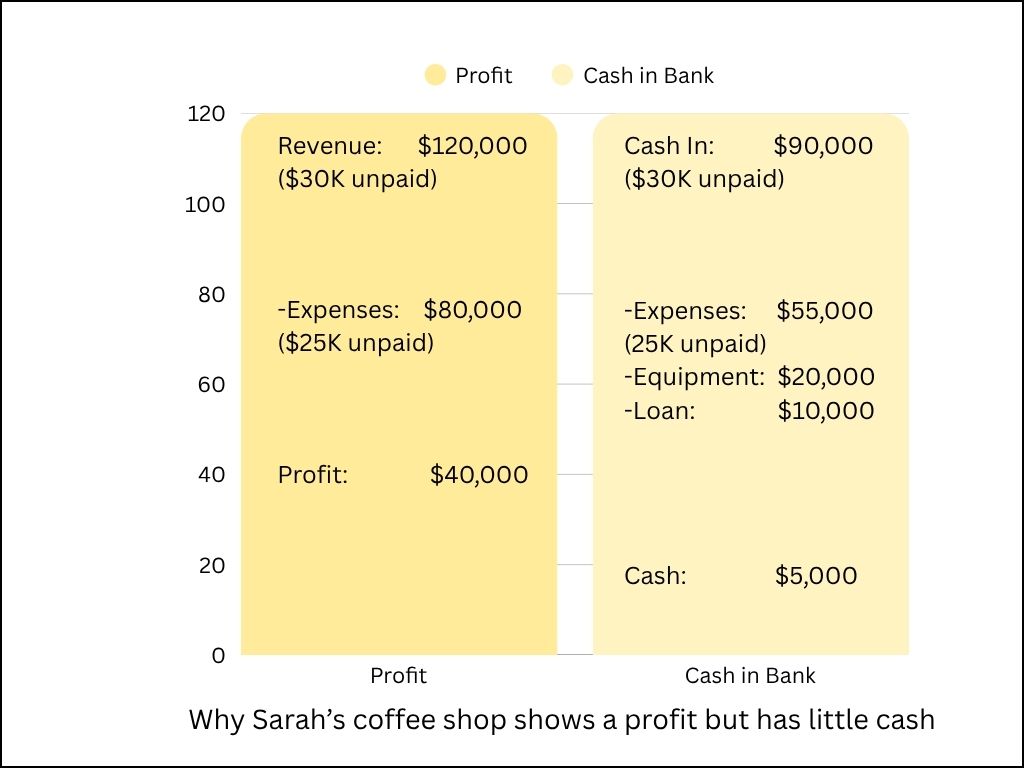
Let’s look at Sarah, who owns a coffee shop. Last year, her financials showed:
- Revenue: $120,000 (coffee sales, including $30,000 from catering invoices not yet paid).
- Expenses: $80,000 (rent, staff, coffee beans, etc. including $25,000 from vendor bills not yet paid).
- Profit: $40,000 ($120,000 – $80,000).
On paper, Sarah’s business is profitable. But her bank account has only $5,000. Why?
- Unpaid Invoices: $30,000 of her revenue is from catering clients who haven’t paid yet.
- New Equipment: Sarah spent $20,000 on a new espresso machine, which is an asset, not an expense, so it doesn’t reduce her profit (it’s depreciated over years).
- Loan Repayment: She paid $10,000 toward a business loan’s principal, which also doesn’t affect profit.
So, while Sarah’s profit is $40,000, her cash is tied up in unpaid invoices, equipment, and loan repayments, leaving her bank account low.
Here’s a visual walk-through of Sarah’s cash flow story—because sometimes numbers make more sense when you can see them.
How to Keep Cash Flow Healthy
To avoid cash flow surprises, try these tips:
- Track Invoices: Follow up on unpaid invoices to get cash in the door faster.
- Plan for Big Expenses: Save for large purchases or spread them out to avoid draining your account.
- Understand Your Cash Flow: Work with a bookkeeper (like us!) to monitor when money comes in and goes out.
- Use Cash Flow Forecasts: Predict future cash needs to avoid shortages.
Even if you use cash basis accounting there can be a difference between your profit and what’s in the bank.
You run your business on a cash basis. That means you only record income when you get paid, and expenses when you actually spend money. So if your books show a profit, shouldn’t your bank account be full?
Not necessarily. Even on a cash basis, profit and cash in the bank don’t always match. Here’s why.
First, What Is “Profit” on a Cash Basis?
- Profit is the difference between the cash you received and the cash you spent.
- It’s calculated from your Profit & Loss Statement, which shows income and expenses during a specific period.
But that profit number doesn’t tell you everything about your cash situation.
A Simple Example: Meet Carla
Carla owns a boutique. Last year:
- She made $100,000 in sales (all paid).
- She spent $70,000 on rent, payroll, and supplies.
- Her Profit & Loss shows a $30,000 profit.
But her bank account only has $5,000. Why?
Here’s where the rest of the cash went:
- She bought $15,000 in inventory in December for next year’s sales.
- She paid off $7,000 in credit card debt.
- She took $3,000 as an owner draw.
Result? Her profit was real—but most of the cash was used elsewhere.
Where Does the Cash Go?
Even on a cash basis, your profit doesn’t include:
- Inventory purchases: You spend cash, but it’s not an expense until sold.
- Loan principal payments: These reduce debt, not profit.
- Owner draws: Taking money out of the business isn’t an expense.
- Equipment purchases: These are assets, not expenses.
- Prepaid expenses: You paid now, but the benefit comes later.
Want to See the Whole Picture?
Ask your bookkeeper for a Cash Flow Summary. It shows how your cash was used—beyond just income and expenses.
???? Final Thought
Cash basis accounting is simpler, but it still doesn’t tell the whole story.
Profit shows how your business is performing overall, but cash flow tells you what’s actually in your bank account. By understanding how money flows through your business, you can avoid the frustration of a profitable business with an empty bank account. At ECB Administrative Services, we specialize in helping business owners like you manage both profit and cash flow. Contact us today to see how we can help you keep your finances on track!